Architecture
How Centaur Works
Four layers. Human vision in. Working software out. Governed at every stage.
ORCHESTRATION
The Chief of Staff layer. Terence coordinates agents, maintains persistent memory, monitors the factory, and escalates to the human when it matters. Everything flows through here: task routing, governance gates, progress tracking.
DELIVERY TEAM
The engineering layer. Nic builds to spec, Ralph gates quality, Scott provides daily intelligence, Quill handles content, Livy owns visual design. Every stage has a named agent accountable for it. Nothing advances without sign-off.
GOVERNANCE RAIL
Runs alongside every stage. Mission Control gives real-time visibility across every agent, project, and pipeline. The Governance Feed logs every commit, decision, and handoff. Anomaly detection flags stalls, quality regressions, and cost spikes before they become problems.
COUNCIL
Multi-model peer review. Before significant work ships, the Council, GPT, Gemini, and Claude, cross-validate the approach. AI peer review as a standard practice, not an afterthought. PASS, REVISE, or BLOCK.
Spec-Driven Development
The Spec is the Contract
Every build starts with a validated spec. The spec is the interface between Maya (Architect) and Nic (Engineer). Nothing gets built without it, and nothing ships without Ralph's gate.
The spec ID is embedded in every record, creating end-to-end traceability from source intent to deployed output. Change the spec, re-run, get an updated build. Reproducible, auditable, diff-friendly.
Sample BronzeSpec (Blueprint)
{
  "spec_id": "bronze_species_plus_v1",
  "source_api": "https://api.speciesplus.net/api/v1/taxon_concepts",
  "target_schema": "agents_and_pencils_dev.bronze",
  "target_table": "species_plus_taxa",
  "columns": [
    { "source_path": "id", "target_name": "taxon_concept_id", "data_type": "INT" },
    { "source_path": "full_name", "target_name": "scientific_name", "data_type": "STRING" },
    { "source_path": "higher_taxa", "target_name": "higher_taxa", "data_type": "STRING" }
  ],
  "incremental_strategy": "append",
  "quality_mode": "warn"
}
Built Using Centaur
Blueprint & Schemata
Blueprint and Schemata are separate products, data platform accelerators built using Centaur. They are proof the model works. Both can be delivered as standalone engagements or alongside a Centaur project.
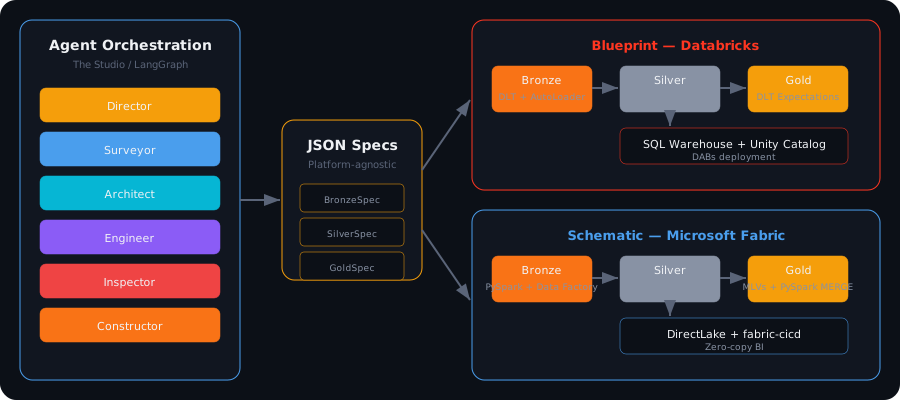
| Component | Blueprint (Databricks) | Schemata (Fabric) |
|---|---|---|
| Bronze ingestion | DLT notebooks + AutoLoader | PySpark notebooks + Data Factory |
| Silver transforms | DLT with Expectations | MLVs with CHECK CONSTRAINT |
| Gold modelling | DLT with Expectations | MLVs + PySpark MERGE |
| Quality enforcement | @dlt.expect (warn/drop/fail) | CONSTRAINT CHECK (drop/fail) |
| Deployment | DABs YAML | fabric-cicd Python library |
| BI endpoint | SQL Warehouse | DirectLake (zero-copy) |
| CI/CD | GitHub → Databricks sync | GitHub/ADO → Fabric sync |